

Subpop | State-Shopping:When Countries Become Political Products
From ideological migration to exit rights, and the question no one wants to answer

This essay extends the framework developed in Rethinking the State: An Evolutionary History of a Power Species, When the State Kills: Violence Immunity and the Grammar of Impunity.
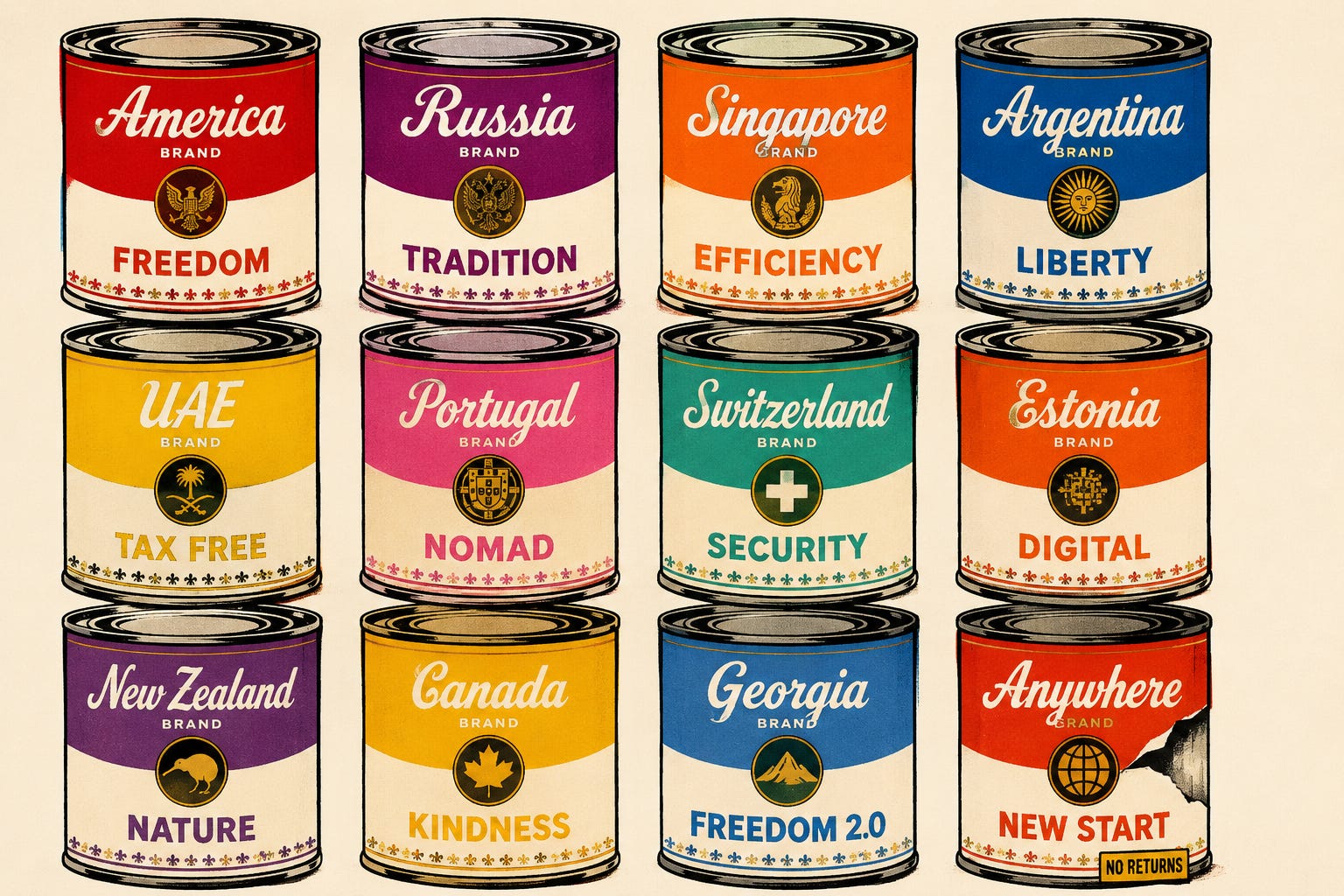
Where This Question Came From
People are already choosing countries the way they choose cities, universities, or employers.
Conservatives move to Russia because they believe it has preserved traditional values their own societies have abandoned. Liberals contemplate leaving America because they cannot accept the political force that has taken control. Digital nomads compare visa regimes the way they compare coworking spaces. Retirees relocate for cheaper healthcare. Wealthy individuals arrange tax residency across multiple jurisdictions. Families move for schools, safety, or a cultural environment that matches their convictions. Billionaires seek out governments that can be shaped around the needs of technological capital.
We rarely describe these choices using the same vocabulary. But they belong to the same phenomenon. Marlene Laruelle, in a recent essay on Peter Thiel’s reported move to Argentina, calls it state-shopping. The term is hers. What this essay attempts is to take the concept further than she did, and to ask a question her analysis opens but does not fully pursue.
Shopping, of course, assumes you can return the product. State-shopping raises a more uncomfortable question: can you?
Laruelle published two articles in July 2026 that placed this question in front of me from two different directions.
The first described a small number of Western conservatives who have relocated to Russia. They are not traditional immigrants pursuing safety, income, or opportunity. They are ideological migrants. They believe their own countries can no longer be repaired through elections, and rather than wait for the next vote, they have gone looking for a country that already embodies their values. Russia offers them what Laruelle calls a fully furnished utopia: traditional family structures, public Christianity, clear gender roles, strong leadership, and a daily life in which their worldview is no longer embattled but ordinary. They are not designing a society that does not yet exist. They are shopping for one that appears to exist already.
The second article described something different. Peter Thiel’s reported move to Buenos Aires is not the act of someone browsing the shelf for a country that fits. Thiel is not an ordinary consumer. In the United States, he can influence a governing coalition, but he cannot insulate that influence from elections and the possible return of the Democrats. Argentina, under Milei, may offer something more durable: a government eager for technological capital, in a country with a long history of concentrated executive power. Laruelle identifies the paradox at the center of this story. Milei is a classical libertarian committed to dismantling the state. Thiel’s politics are postlibertarian: hostile to regulation and democratic constraint, but dependent on a state capable of concentrating power around the needs of technological capital. Milei can clear the institutional terrain. Thiel can supply a model for rebuilding selected parts of it around technological firms. The result is not anarcho-capitalism. It is a public-private state.
Ordinary state-shoppers choose among states. Powerful state-shoppers try to redesign the shelf.
These two stories look very different. One involves families searching for moral order. The other involves a billionaire searching for political leverage. But they share a structural logic that, once visible, is difficult to unsee. Both treat the state not as a given, but as a product that can be evaluated, compared, and selected. Both assume that when politics at home becomes intolerable, the appropriate response is not to stay and fight, but to leave and find something better.
1. State-Shopping Is Not a Partisan Phenomenon
It would be easy to frame this as a story about the right. The Western conservatives moving to Russia are ideological migrants of the right. Thiel operates within a postlibertarian politics that emerged from the right-libertarian tradition. But state-shopping is not a right-wing phenomenon. It is a structural shift in how people relate to states, and it crosses every ideological boundary.
Consider the symmetry. When Trump returned to the White House, a wave of liberal Americans began publicly contemplating departure. Some were celebrities, some were intellectuals, some were ordinary citizens. Their direction was opposite to the conservatives heading for Russia, but their behavioral logic was identical: when the political force you find intolerable takes control of the state, exit begins to replace repair.
Digital nomads choosing countries based on cost of living, tax structure, and visa convenience are state-shoppers. Retirees relocating to countries with cheaper healthcare are state-shoppers. Families choosing countries based on school systems, safety, or cultural environment are state-shoppers. Wealthy individuals arranging tax residency across multiple jurisdictions are state-shoppers. They may not use the word. They may not think of themselves as making a political choice. But structurally, they are doing the same thing: treating the state as a service that can be compared, rated, and switched.
There are people who leave because a country is too liberal. There are people who leave because a country is not liberal enough. The ideological content differs. The underlying assumption is the same: the state is no longer a fate. It is an option.
2. A Market That Already Exists
State-shopping is not a future possibility. It is a present reality. States are already marketing themselves as products.
Investment migration programs, digital nomad visas, golden passports, startup residencies, special economic zones: these are not exceptions or loopholes. They are deliberate strategies by which states compete for residents, capital, and skills on a global market. The language of branding, customer acquisition, and product differentiation has already entered the vocabulary of national immigration policy. Countries advertise themselves. They design visa products for specific consumer profiles.
If the framework developed in Rethinking the State is correct, and the state is a power organism rather than a sacred and irreplaceable civilizational container, then what we are witnessing is exactly what that framework would predict: different power organisms competing for the resources they need to survive. Residents, capital, technology, and allegiance are the nutrients. Visa programs and tax incentives are the mechanisms of competition. The power organism does not wait passively for people to be born within its territory. It actively recruits.
Beyond the competition between existing states, a further step has already been taken. Some people are no longer satisfied with choosing among existing options. They want to build new ones. Balaji Srinivasan’s Network State theory, Vitalik Buterin’s Zuzalu experiment, the Próspera charter city in Honduras, various seasteading proposals and startup society projects: these differ enormously in form, scale, and seriousness, but they share a common premise. If no existing state is good enough, perhaps it is possible to create one from scratch. They are not shopping on the existing shelf. They are attempting to manufacture a new product. These experiments deserve their own analysis, and I will return to them in a future essay. Here, I want only to mark their existence, because they complete the spectrum: from choosing among states, to redesigning states, to building states.
But whether one is choosing, redesigning, or building, the metaphor of shopping conceals a problem that becomes visible only when you examine what a state actually is.
3. A Market Without Consumer Sovereignty
If state-shopping already exists, it may seem reasonable to treat the global system as a market. States offer governance products. Individuals compare options. Capital flows toward the best deals. The analogy is intuitive. It is also deeply misleading.
In a normal market, consumer sovereignty is the foundational assumption. The buyer evaluates, selects, purchases, and can return the product or switch to a competitor. The seller cannot prevent the buyer from leaving. The seller cannot detain the buyer. The seller cannot confiscate the buyer’s property as a condition of exit. The seller cannot declare the buyer illegal for having entered the store without the right paperwork.
The state-shopping market violates every one of these conditions.
States can select their customers. They can require wealth, education, professional qualifications, language proficiency, ethnic background, political loyalty, health status, and clean criminal records. They can accept or reject applicants based on nationality, which is to say, based on the accident of birth. A passport issued by one country opens doors that a passport issued by another country does not. The same person, with the same skills, the same character, the same intentions, faces radically different options depending on which state happened to contain the hospital where they were born.
Consumers, meanwhile, cannot equally select states. Whether a person can enter, work, stay, or become a citizen of another country depends on their passport, their wealth, their employer, their family connections, and the diplomatic relationship between their country of origin and their desired destination. These are not market conditions. They are conditions of birth, privilege, and geopolitical accident.
The only market where the consumer is not sovereign is the market for sovereignty itself.
State-shopping, as it currently exists, is a luxury market. The wealthy can arrange their lives across multiple jurisdictions, optimizing for tax efficiency, political stability, lifestyle preferences, and personal safety. The poor, attempting to cross the same borders for the same reasons, may be classified as illegal immigrants, detained, deported, or left to drown.
State-shopping already exists. It is simply reserved for those whom states consider desirable customers.
Modern states increasingly compete like products while continuing to exercise the coercive authority of sovereigns. State-shopping emerges precisely from this contradiction: the state is being commodified, but sovereignty is not.
4. Violence Immunity: Why a State Is Not a Product
The asymmetry of the state-shopping market is not merely a matter of inequality, although it is that. It points to something more fundamental. A state is not a product. The difference is not one of scale, complexity, or public versus private ownership. The difference is that a state possesses what I have called, in When the State Kills, violence immunity.
A company can refuse to serve a customer. It cannot legally detain one. A company can terminate a contract. It cannot confiscate a person’s identity documents. A company can go out of business. It cannot conscript its former employees into military service. A company can charge fees. It cannot block a person from leaving the premises, imprison those who entered without authorization, or strip a person of the legal right to work anywhere else.
A state can do all of these things. And within its own sovereign territory, the accountability for doing them often terminates at the state itself.
This is not a peripheral feature of statehood. It is the defining feature of the power organism. Rethinking the State argued that the state is not a contract, not a service provider, not a platform. It is a power organism with its own immune system, its own narrative metabolism, its own homeostatic logic. Violence immunity is not an incidental attribute of this organism. It is what makes the organism a state rather than a company, a club, or a voluntary association. The power organism monopolizes not only the use of violence, but also the consequences of violence. It controls whether its own violence is investigated, how it is described, and whether anyone is held responsible.
This is the contradiction at the heart of the state-shopping metaphor. You are not selecting a service provider. You are entering a structure that possesses the ultimate coercive power, and that power includes the power to determine whether, when, and under what conditions you may exit.
Return to Laruelle’s first story. The Western conservatives who moved to Russia are enjoying a specific structural position: the expatriate buffer. They experience the state’s ideological order as confirmation of their values. They enjoy the furnished utopia. But they are experiencing Russia as visitors with exit options, not as Russian citizens subject to the full weight of the Russian state. If they were subject to military conscription, to restrictions on emigration, to the consequences of political dissent, to the judicial system as experienced by ordinary Russians rather than by ideologically sympathetic foreigners, would they have made the same choice?
The consumer believes they are choosing a lifestyle. They are actually entering a violence structure. The shopping metaphor makes this invisible, because shopping assumes you can return the product. A state is not a product you can return. A state is a power organism you have entered, and exit is a privilege it may or may not grant.
5. The Freedom That Matters Is Exit
Liberalism has always emphasized the freedom to choose. Choose your government through elections. Choose your beliefs. Choose your profession. Choose where to live. State-shopping extends this logic to its apparent conclusion: choose your country.
But the analysis above reveals that the freedom to choose a country is not, by itself, a meaningful freedom. It becomes meaningful only when combined with another freedom, one that is far more rarely discussed and far more fiercely resisted by states.
The freedom to leave.
A choice is not free if it becomes irreversible once made. A contract you cannot exit is not a contract. It is a sentence. If state-shopping is to mean anything more than a privilege for the wealthy, it requires that exit be treated not as a concession, not as a bureaucratic possibility, not as a favor granted by a benevolent state, but as a fundamental political right.
If exit were treated as a genuine political freedom, it would imply at least the following: the right to leave any state without criminal penalty. The right to take one’s legally acquired property. The right not to be detained on the basis of immigration status. The right to live and work legally in another jurisdiction. The right not to be rendered stateless. The right not to be forced into irrevocable political allegiance as a condition of residence.
None of these conditions are universally met today. Many states restrict emigration. Many states tax departure. Many states refuse to release citizens from obligations even after they have left. Many states detain, deport, or criminalize people whose only offense is having crossed a border without authorization. The global system is not a market with free entry and exit. It is a patchwork of sovereign territories, each of which claims the right to control who enters, who stays, who works, and who leaves.
And this brings us back to the framework of Rethinking the State. If the state is a power organism, then its resistance to exit is not a policy choice. It is a survival instinct. People are the state’s primary resource. Their labor, their taxes, their allegiance, their reproductive capacity, their willingness to fight: these are the nutrients the power organism consumes. A state that allows unrestricted exit is a state that accepts the possibility of losing its resource base. No organism does this voluntarily. The power organism will always tend to restrict exit, because exit threatens its metabolic inputs.
This is why the liberal ideal of state-shopping, taken to its logical conclusion, is so radical. It does not merely propose that people should be able to choose where to live. It proposes that states should not be allowed to treat people as their natural property. It proposes that the relationship between a person and a state should be, in principle, dissolvable. And that proposition strikes at the deepest structural assumption of sovereignty itself: that the sovereign’s authority over those within its territory is, in the final analysis, not subject to negotiation.
6. The Test
The stories that began this essay point in different directions, but they converge on the same question.
Western conservatives who moved to Russia believe they have found a fully furnished utopia. They may be right about the furniture. They have not yet been tested on the locks.
Peter Thiel may be looking for a state that can be reshaped around the needs of technological capital. He may succeed. But a state reshaped around technological capital is still a state, and a state’s defining characteristic is that it possesses the coercive power to determine the terms of its own relationships.
Digital nomads optimizing their lives across jurisdictions believe they are free consumers in a global market. They are, for now. Their freedom depends on the continued willingness of states to compete for them. If states decide to restrict mobility, that freedom evaporates. It was never a right. It was an offer.
Network states, charter cities, and startup societies propose to build new governance structures from scratch. Some of these proposals are serious and worth examining carefully. But none of them escape the fundamental question: will the people inside them be free to leave?
State-shopping, as a liberal ideal, would not be a world in which everyone finds the perfect state. No such state exists. It would be a world in which choosing the wrong state is no longer a life sentence. States could still ask for loyalty, participation, and responsibility. But they could no longer claim ownership over the people who live within them.
That ideal is worth stating clearly, even if it is far from being realized. Because the alternative is what we already have: a world in which the ability to choose your state is distributed according to wealth, passport, and the accident of birth. A world in which state-shopping is a freedom, but only for those whom states have decided to welcome. A world in which borders are open upward and closed downward. A world in which the same act of crossing a line on a map is called expatriation for the rich and illegal immigration for the poor.
The real test of a political community is not whether people are willing to enter it. It is whether they remain free to leave.
P.S.
As this essay was being completed, a case unfolded that could have been written as its illustration. Balaji Srinivasan’s Network School, operating in Forest City, Johor, had its business license revoked by Malaysian authorities on July 22, 2026. The Johor state government cited violations of licensing conditions and issued a pointed reminder: no investor, company, or organization may be placed above the sovereignty of the country’s laws.
Within twenty-four hours, Srinivasan announced that a memorandum of understanding had been signed with Kazakhstan to establish a new campus there, complete with faster visa processing, relocation support, and talent recruitment infrastructure.
The sequence is worth pausing on. A startup society is expelled from one sovereign jurisdiction and, within a day, signs an agreement with another. The community does not dissolve. It migrates. One power organism rejects the resource; another moves immediately to capture it.
This is state-shopping operating at institutional speed. And it confirms both sides of the contradiction this essay has tried to describe. On one hand, governance is becoming something that can be compared, negotiated, and switched. On the other, the Malaysian government’s statement made the underlying reality explicit: sovereignty is not a product. It is the authority that decides whether a product is allowed to exist on its territory.
Srinivasan can move. His community can move. Their capital, networks, and organizational capacity are portable. But their portability depends entirely on the willingness of another sovereign to receive them. They are free to leave Malaysia. Whether they remain free to leave Kazakhstan has not yet been tested.
Deep Bitcheese Brew is an Analog × Artificial Writer exploring power, hallucination, sovereignty, and civilization.
In your previous series on the state as an evolutionary organism, the earliest forms of the state included tribes and the freedom to leave. That freedom was the first thing to leave as we shifted to a more advanced form of the state. So do you view this development as a retrogression? Or is it a coincidence that both the earliest forms of the state and the ideal form of the state possess this characteristic of freedom to exit?