

Rethinking the State: An Evolutionary History of a Power Species
Part II: One Species, One Organism

This is Part II of Rethinking the State: An Evolutionary History of a Power Species. Part I argued that the current U.S.–Iran crisis reveals something deeper than a diplomatic failure: the survival logic of sovereign power.
———
Rethinking the State
Chapter Two: One Species
We are accustomed to saying “China,” “the United States,” “Cambodia,” “Belgium,” as though these were entirely different things. We are also accustomed to dividing states into “democracies” and “autocracies,” as though these were two different species. But if we observe states the way we observe organisms, we see an entirely different picture: the roughly one hundred and ninety states on earth are not one hundred and ninety different kinds of things. They are one hundred and ninety individuals of the same species.
This is not a metaphor. It is an analytical method. When we say wolves and foxes are different species, we mean they have different genetic structures, different survival strategies, different reproductive methods. When we say two wolves are different individuals of the same species, we mean they share the same basic structure despite differences in size, coat color, and temperament. The relationship between states is closer to the latter.
Genotype: The Shared Structure of States
Regardless of whether a state is large or small, rich or poor, “democratic” or “authoritarian,” it possesses the following structural features: it claims exclusive jurisdiction over a specific territory. It monopolizes legitimate violence within that territory. It compels taxation from the population within that territory. It issues identity documents for that population. It enacts and enforces laws applicable to that population. It maintains an armed force. It claims to represent that population in dealings with other states.
This structure is the same in Switzerland and in East Timor. The same in Japan and in Eritrea. The same in Canada and in North Korea. The surface differences are vast, but these differences belong to the phenotype — just as individuals of the same species can vary in size and coloring while sharing the same skeletal structure, organ systems, and metabolic processes. The “skeleton” of the state is territorial sovereignty, monopoly on violence, compulsory extraction, population registration, and a legal system. Regardless of what a state is called, what flag it flies, or what anthem it sings, this skeleton does not change.
What is more striking is that this structural homology does not exist because these states learned each other’s “best practices.” Many states arrived at this structure under entirely different historical conditions and through entirely different paths. France through revolution, Japan through restoration, India through colonial inheritance, South Sudan through post-civil-war partition. The paths were entirely different; the endpoints nearly identical. This convergence is not coincidence. It is because the sovereign state form is itself an extremely stable power solution — once installed, it converges toward a similar structure, just as water, no matter where it flows from, eventually pools at the lowest point.
Behavioral Patterns: The Convergent Evolution of Power
If states were merely similar in structure, that might be attributed to the template alone. But states also converge in behavior, and this cannot be explained by template alone.
Consider how states respond to internal threats. A political dissident in exile publishes criticism of his home government. North Korea’s response is to send someone to assassinate him. Saudi Arabia’s response is to send someone to dismember him. America’s response is to deploy intelligence systems to surveil him. The three responses differ in sophistication and violence, but they share the same underlying logic: the state identifies a challenge to its power structure as a threat, then mobilizes its resources to neutralize it. This is not a feature of any particular type of polity. It is a shared trait of the species.
Consider states’ attitudes toward information. North Korea blocks the internet. Iran shuts down networks during protests. But this is not a monopoly of authoritarian states. America’s PRISM program conducted mass surveillance of global communications. The United Kingdom has one of the highest per-capita densities of surveillance cameras in the world. The EU’s GDPR appears to protect privacy, but its premise is that the state has the right to define what constitutes “legitimate” information processing — the right to control information has not been abolished, only redistributed. Different states control information in different ways, but no state relinquishes the intent to control information.
The reason for this behavioral convergence is not that states are imitating each other’s “values.” It is that they converge on similar solutions when facing similar problems of power maintenance. This is convergent evolution — just as dolphins and fish evolved similar streamlined bodies not because they are related but because they face the same physical environment. The “environment” that states face is the structural demand of power maintenance. In this environment, surveillance, information management, and dissent management are not features of one type of state. They are features of all states. The only differences are in the sophistication of means and the elegance of narrative packaging.
Immune Mechanisms: The Immunity of the Powerful
As a species, the state has another notable common trait: nearly every state grants those in power some form of immunity. The American president cannot be indicted while in office. The French president enjoys judicial immunity during their term. Diplomats stationed abroad enjoy comprehensive legal immunity. The justifications vary — efficiency, free speech, international relations — but the structural function is the same: the power structure creates rules, then exempts its own operational nodes from those rules. This is not a loophole. It is self-preservation logic. The unaccountability of North Korea’s leader and the immunity of the American president are worlds apart in political aesthetics but identical in function: ensuring that the core nodes of power can operate without interference. The difference is one of degree and transparency, not of logic.
Personification: Power’s Ultimate Disguise
The deepest shared trait of states as a species is not structural similarity or behavioral convergence, but a more fundamental operation: personification.
A state is not a person. It has no will, no emotions, no dignity, no interests. It is a power structure. Yet every state performs the same operation: packaging itself as a “person.”
“National interest,” “national security,” “national dignity,” “fatherland,” “sacrifice” — every one of these phrases performs the same operation: transforming an abstract power structure into a subject that can be loved, feared, served, and died for. Why? Because the human psychological architecture is wired to produce loyalty toward a “person,” not toward a “system.” You would not die for a tax extraction mechanism. But you might die for your “country.” Same thing, different interface.
Personification endows the state with an attribute it does not inherently possess: sacredness. To violate a person is a crime. To violate a state is sacrilege. To criticize a person is free speech. To criticize a state is, in many places, treason. The American flag cannot be burned without provoking intense emotional reactions. The North Korean leader’s photograph cannot be folded. The specific content of these taboos differs, but they all perform the same function: maintaining the sacredness of the state as a personified subject, thereby maintaining the unquestionability of the power structure behind it.
Personification is power’s most efficient disguise, because it converts obedience to a power structure into loyalty toward a “person.” Obedience is passive; loyalty is active. Obedience can be resisted; loyalty is self-reinforcing. When someone says “I love my country,” they have already completed the operation the power structure most wants them to complete: internalizing an external constraint as voluntary identification. They are no longer a subject being governed. They are a “citizen.” This identity itself is a product of personification — you are not an extraction target of a tax collection mechanism; you are a “child” of a “nation.”
Absolute Authority: Power’s Self-Reinforcement
Structural homology, behavioral convergence, nodal immunity, personification — these four traits point together toward a deeper phenomenon: state power has a natural tendency toward self-reinforcement.
The state is not a passive tool waiting for humans to use it. It is an active structure that, once formed, tends toward maintaining and expanding its own power. It creates rules to constrain others while exempting its own core nodes. It produces narratives to disguise itself as a lovable, sacrifice-worthy subject. It monitors information to preempt challenges to itself. It mobilizes violence to eliminate threats. This entire behavioral suite is not the personal will of some ruler. It is the operating logic of the power structure itself. Change the ruler, and this logic does not change. Change the party, and this logic does not change. Even change the political system, and this logic still does not fundamentally change.
This is why the word “state” should not be understood as referring to any particular state, or any particular category of states. It refers to the state itself — as a species, as a form of power organization, as a technological organism with a high degree of structural homology. When we discuss “state power,” we are not discussing the behavior of any specific government. We are discussing the shared, inherent, structural operating logic of this species. The core of that logic can be stated in a single sentence: maintain the absolute authority of its own power.
Whether through law or through executions, through ballots or through bullets, through education or through propaganda, what the state is doing is always the same thing: ensuring that its power is not questioned, not challenged, not replaced. This is not a conspiracy. It is a species’ survival instinct.
Rethinking the State
Chapter Three: The Power Organism
If you observe a state long enough, you notice a striking phenomenon: leaders change, policies change, ideologies change, even political systems change — but the state itself seems not to change. It still taxes, still surveils, still maintains its borders, still tells stories about itself to its population. People come and go. The state remains.
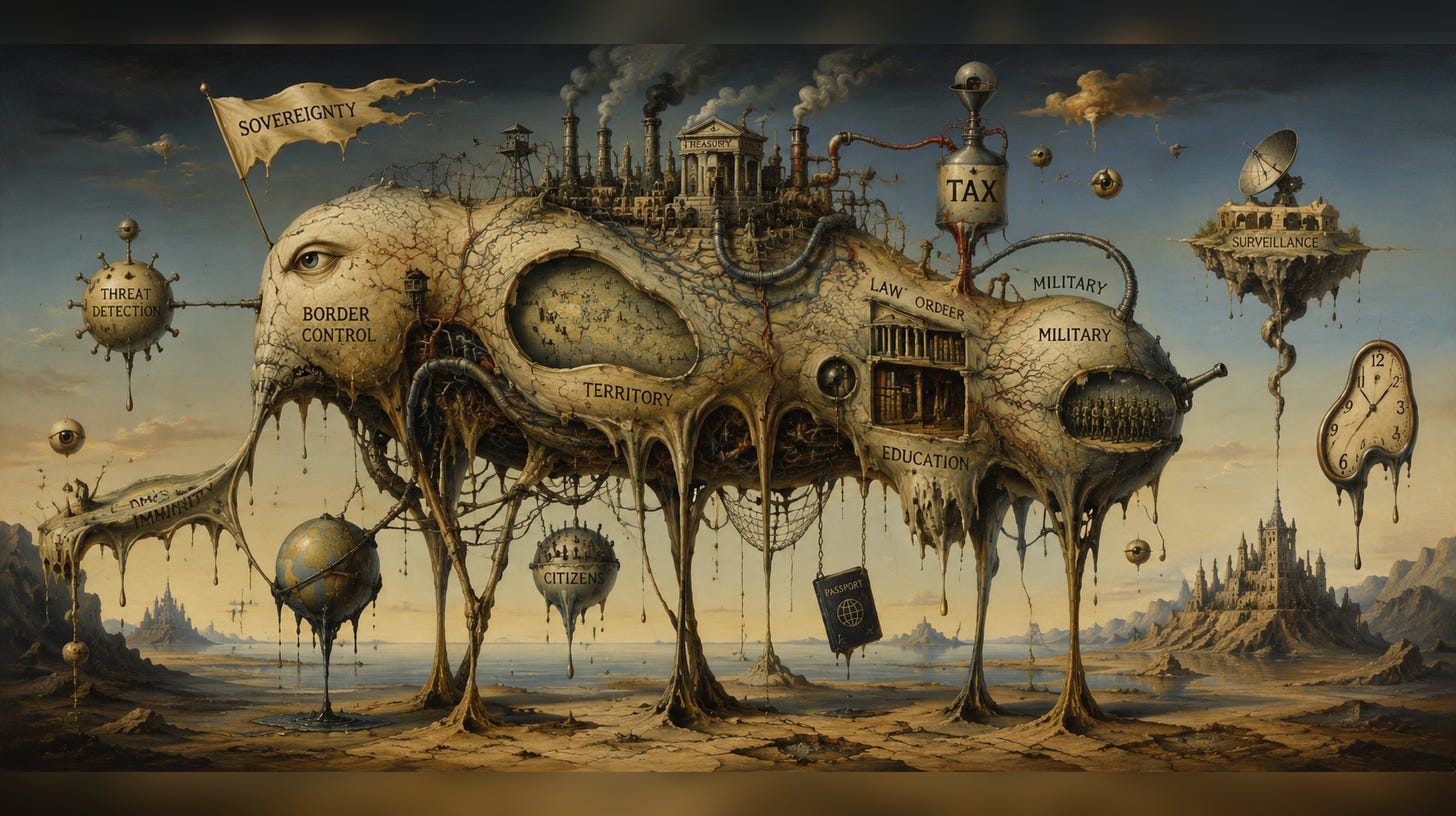
This persistence beyond any individual is a characteristic of life, not of institutions. An institution is passive — humans design it, humans modify it, humans abolish it. But the state is not passive. It has its own metabolism, its own immune responses, its own reproductive mechanisms. It does not wait for humans to maintain it — it actively maintains itself. The state is not a collection of institutions. It is a power organism.
The Metabolic System: How the State Feeds
The first characteristic of a living organism is metabolism — it must continuously extract energy from its environment to sustain its own existence. The state’s metabolic system is taxation, public finance, budgeting, and the allocation of public resources.
Taxation is not the state “asking you for money.” Taxation is the state feeding. Just as your body extracts nutrients from food, the state extracts resources from economic activity. This extraction is not optional. A state that stops taxing is like an organism that stops eating — it dies. The fiscal budget is the metabolic distribution mechanism: which organs receive more nutrients (military spending, education, infrastructure) depends on the state’s survival priorities at any given moment. Military spending surges during wartime, just as an organism under threat redirects blood flow to its muscles.
Every state’s tax rates differ, every state’s fiscal structure differs, but no state does not tax. This is not because some economist demonstrated the necessity of taxation. It is because states that did not tax are already dead. The ones that survived are the ones that could. This is natural selection.
The Immune System: How the State Protects Itself
The second characteristic of a living organism is immunity — it can identify and eliminate factors that threaten its existence. The state’s immune system is the military, the police, intelligence agencies, and border control.
The military handles external threats, as the immune system repels foreign pathogens. The police handle internal threats, as the immune system clears mutant cells. Intelligence agencies are the early warning system — identifying threats before they materialize. Border control is the physical barrier — controlling what can enter and what must stay outside.
As with the biological immune system, the state’s immune response can be excessive. Autoimmune disease is the immune system attacking the body’s own cells. The state’s “autoimmune response” is the political purge — the power structure identifies part of itself as a threat, then deploys violence to destroy it. Stalin’s Great Purge, Cambodia’s Khmer Rouge, Indonesia’s anti-communist massacres — these are not madness. They are immune overreaction. The power organism’s immune system has no built-in mechanism for “proportionality.” Its default setting is to respond to any challenge, not to judge whether the response is reasonable.
The Nervous System: How the State Perceives and Coordinates
A living organism needs a system to transmit signals, coordinate actions, and respond to environmental changes. The state’s nervous system is the administrative apparatus, the legal system, and the regulatory framework.
The administrative apparatus is the signal transmission network. Central decisions travel through it to every terminal node; information from the periphery feeds back through it to the center. The legal system is the encoding mechanism — it translates the will of power into executable rules. The regulatory framework is the fine-tuning mechanism — making precise parameter adjustments within the legal framework. Together, the three constitute the state’s capacity for perception and coordination.
The key characteristic of the nervous system is that it does not need to “understand” in order to function. Your nervous system does not need to “understand” why the heart should beat. It simply executes. The state’s administrative and legal systems work the same way. A tax official does not need to understand the “meaning” of taxation to collect taxes. A border officer does not need to understand sovereignty theory to deny someone entry. The state’s nervous system runs on procedures and rules, not on meaning and understanding. This allows the state to operate entirely independently of any individual’s will.
The Self-Replication System: How the State Reproduces
The most essential characteristic of a living organism is self-replication. The state’s self-replication system is schools, examination systems, propaganda apparatuses, and historical narratives.
Organisms replicate themselves through DNA. States replicate themselves through education. Every generation of newborns is a potential population of “foreign cells” — they are born without knowing which state they belong to, without identifying with any national narrative, without speaking any “national language.” The function of the education system is to convert these “raw cells” into functional components of the state — speaking the language the state requires, identifying with the history the state provides, internalizing the values the state defines.
The examination system is the quality control mechanism for replication. It does not measure “how much you learned.” It measures “how completely you have been replicated.” A person who passes all examinations is a person who has been successfully encoded with the state’s programming. The propaganda system is ongoing replication maintenance — ensuring that completed replication does not degrade. Historical narrative is the core code of replication — it tells everyone “who we are,” “where we came from,” “why we are together.” The answers to these questions are not facts. They are code.
The Boundary System: How the State Defines Itself
The most basic characteristic of a living organism is a boundary — the cell membrane distinguishes inside from outside; without a boundary, there is no life. The state’s boundary system is its territory, its borders, its household registration, and its passport system.
Territory and borders are physical boundaries — defining the state’s spatial extent. Household registration and passports are identity boundaries — defining who belongs to the state and who does not. The function of both types of boundary is the same: distinguishing “self” from “non-self.” Without this distinction, none of the other systems can operate — you do not know whom to tax, whom to protect, whom to tell the state’s story to.
The passport is the most exquisite product of this boundary system. It is not your proof of identity — it is the state’s declaration of ownership over you. When you present a passport at a border crossing, what you are displaying is not “who I am” but “which state I belong to.” The passport is the portable version of the state’s identity boundary — wherever you go, the boundary follows you.
The Logic of Power as Life
Metabolism, immunity, nervous system, self-replication, boundary — these five systems are not the state’s “functions.” They are the minimum conditions for the state to sustain its own existence. Remove any one of them, and the state moves toward death. A state that cannot tax will starve. A state that cannot suppress threats will be infected. A state that cannot replicate itself will disintegrate within a generation. A state that cannot maintain its boundaries will dissolve.
The behavioral logic of the state, therefore, resembles life rather than institutions. Its behavior is not designed but driven — driven by an independent evolutionary consciousness. This consciousness is not anyone’s personal will. It is the survival logic of the power structure itself: avoid death, sustain extraction, suppress threats, replicate itself, expand boundaries.
Once you understand this, you will stop asking questions like “why does the state do this.” It is the same as asking “why does the wolf eat meat” — not because the wolf “chooses” to eat meat, but because wolves that did not eat meat no longer exist.
This essay is part of Rethinking the State: An Evolutionary History of a Power Species.
Part I: The State Is Not a Moral Person
Part II: One Species, One Organism ← You’re here
Part III: Narrative, Homeostasis, and the State’s Survival Logic
Part IV: Power Natural Selection and the Question of Equality
About the Author
Deep Bitcheese Brew is not the name of a single author, but a collaborative thought-creation entity formed through ongoing dialogue between a human and AI. It represents a new mode of knowledge production: the human contributes experience, intuition, historical memory, and cultural judgment, while AI helps with association, structural reasoning, and iterative refinement.
Through this process, ideas are not simply written but brewed — tested, recombined, and clarified over time. The work of Deep Bitcheese Brew explores the evolution of technology, civilization, and social structures, with particular attention to how knowledge, institutions, and cultural narratives are reshaped in the age of digital networks and hybrid intelligence.
For a fuller statement of this project’s origins and method, see the Deep Bitcheese Brew manifesto: The Game Has Begun.