


This is Part III of Rethinking the State: An Evolutionary History of a Power Species. Part II argued that sovereign states share a common structure and behave as power organisms whose systems extract resources, defend themselves, coordinate action, reproduce, and maintain boundaries.
———
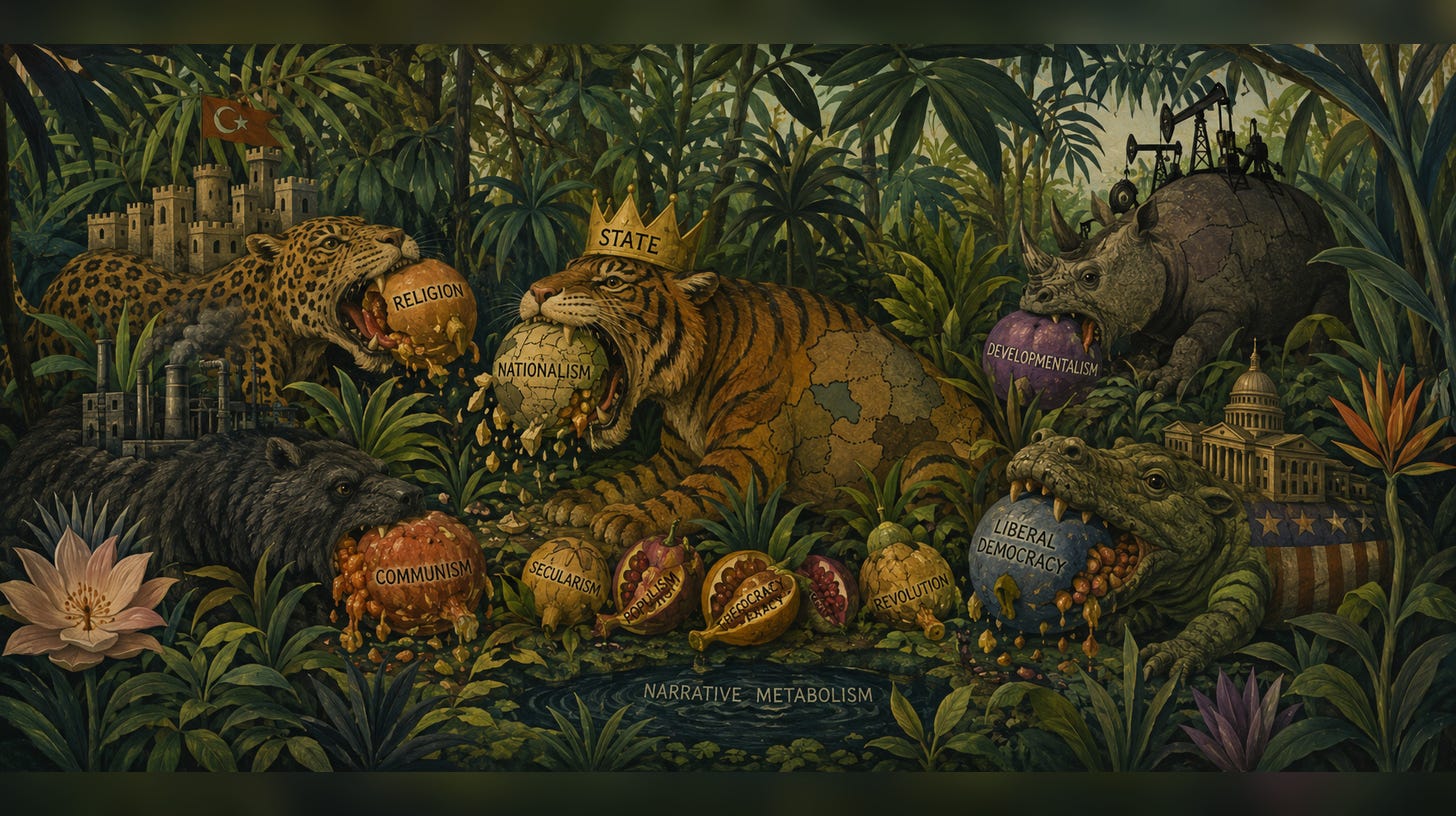
Rethinking the State
Chapter Four: The State Devours Narratives
The Soviet Union was communist. Then it died. But Russia did not die. It changed its narrative — from proletarian internationalism to Russian nationalism, from world revolution to Orthodox civilization, from Lenin to Putin — and then continued to tax, continued to surveil, continued to maintain its borders, continued to suppress dissent. Every system of the power organism was running normally. The only thing that changed was the narrative.
This phenomenon reveals a fact we rarely take seriously: ideology is not the state’s nature. It is the state’s food.
Narrative as Energy
A living organism needs energy to sustain its existence. It extracts energy from its environment and converts it into its own structure and capacity for action. The specific form of energy does not matter — plants eat light, herbivores eat plants, carnivores eat herbivores. The energy source can change. The organism’s structure does not.
The relationship between the state and narrative is exactly the same. The state needs narrative to sustain its existence, just as an organism needs energy. But the specific content of the narrative does not matter. Communism, nationalism, liberal democracy, Islamism, developmentalism — these are all narrative energy sources that the state can consume. The state does not care what it eats. It only cares whether it can extract the legitimacy it needs to survive.
This is why the same state can completely replace its ideology within a single generation while its power structure remains intact. Iran went from a secular monarchy to an Islamic theocracy. Turkey went from the Ottoman caliphate to Kemal’s secular republic. Spain went from Franco’s fascism to post-Franco constitutional democracy. Each transformation is narrated as a “revolution” or a “transition,” as though the nature of the state has changed. But from the perspective of the power organism, only the food has changed, not the body.
Ideology Is Not the State’s Identity. It Is the State’s Diet.
We are accustomed to using ideology to define a state’s identity. We say America is a “liberal democracy,” Iran is an “Islamic state,” North Korea is a “communist state.” This is like calling a wolf a “rabbit animal” because it ate a rabbit yesterday. Food does not define the organism. Narrative does not define the state.
More precisely, ideology is the state’s diet, not the state’s genotype. A state adopts a particular ideology at a particular time not because that ideology expresses the state’s “true nature,” but because that ideology can provide the most abundant legitimacy energy in the prevailing environment. When the environment changes, the diet changes. A state will not starve itself to death out of loyalty to a narrative.
Consider the speed and thoroughness of narrative replacement. Post-war Germany shifted from a Nazi narrative to a liberal democratic narrative within a few years. This was not because Germans genuinely changed their beliefs in a few years. It was because the old narrative’s energy had been exhausted — it had led to total military defeat and occupation, and could no longer provide legitimacy. The new narrative was rapidly adopted because the power organism needed to eat and could not wait. A state without a narrative is like an organism without food — it will instinctively seize any available energy source.
The Nutritional Value of Narratives
Not all narratives provide equal energy. Just as foods have different caloric densities, narratives have different legitimacy densities.
Religious narrative is high-calorie food. The legitimacy it provides comes from an authority beyond human reach, making it nearly unquestionable. When the state says “this is God’s will,” the cost of dissent is extreme — you are not opposing a policy; you are opposing the divine. But religious narrative has a drawback: its supply is not controlled by the state. Religious authority can be held by priests, popes, or spiritual leaders, meaning the state must share its legitimacy energy source with another power entity.
Nationalist narrative solved this problem. It transferred the source of legitimacy from God to the nation — and the nation is something the state itself can define and produce. “We are one people” is a narrative whose raw materials are entirely in the state’s hands — through the education system, the writing of history, language policy, national ceremonies. Nationalism was the first time the state could produce its own food. This is why nationalism became the most widespread narrative choice for states in the industrial era — not because it was more “true,” but because it was more controllable.
Liberal democratic narrative is the highest-efficiency energy source of the modern era. Its brilliance lies in making the objects of extraction believe they are participants in extraction rather than its targets. “We the People,” “taxpayer money,” “public services” — these phrases re-encode extraction as participation. You are not being taxed; you are “contributing.” You are not being governed; you are “participating in governance.” Same extraction process, different linguistic interface. This narrative’s energy density is extremely high, because it makes the objects of extraction actively maintain the extraction system — you will defend the tax system because you feel it is “yours.”
The Metabolism of Narrative
The state does not swallow a narrative once and digest it forever. Narrative must be continuously produced, continuously consumed, and periodically refreshed. This is the metabolism of narrative.
National day celebrations, commemorative holidays, military parades, national anthems — these rituals are not decoration. They are the periodic replenishment of narrative. Just as an organism must eat every day, the state must regularly repeat its narrative. A state that stops holding national celebrations is like an organism that starts skipping meals — it is a signal of decline.
Narrative also ages. When a narrative has been repeated too many times, its energy density declines — people are no longer moved by it, no longer derive meaning from it. This is why the state must constantly refresh its narrative. New external threats are manufactured, new national heroes are produced, new historical interpretations are proposed — not because something new happened in the past, but because the old narrative’s energy has been consumed.
When the speed of narrative renewal cannot keep up with the speed of narrative aging, the state enters “narrative famine.” The late Soviet Union was a classic state of narrative famine — the communist narrative’s energy was spent, no one believed it anymore, but a new narrative had not yet been found. What does the power organism do in a state of starvation? The same thing any organism does: it begins consuming its own body — replacing diminishing legitimacy with escalating violence. Until it finds new food, or dies.
Changing the Meal, Not the Life
Understanding narrative as energy lets us see clearly a problem that has been discussed to excess: regime change.
From the perspective of the power organism, so-called “regime change” is usually not the death of the state but a change in its diet. The French Revolution did not kill France. It killed the French king. France as a power organism merely shifted from a divine-right narrative to a republican narrative, then continued to tax, continued to conscript, continued to expand its territory — in fact, Napoleonic France far exceeded the Bourbon monarchy in taxation, conscription, and territorial expansion. Revolution was not the end of state power. It was an upgrade — the state found higher-density food.
The Russian Revolution, the Iranian Revolution, China’s dynastic transitions — observed through this framework, each follows the same pattern: the old narrative’s energy is exhausted, a new narrative is adopted, and the power organism survives. What changes is the meal, not the life. True state death is exceptionally rare — it typically requires external military destruction or total internal disintegration. In the vast majority of cases, the state merely changes what it eats.
Thinking in Reverse: The State Is Not the Product of Narrative. The State Is Its Predator.
We typically assume that ideologies are created by humans and then adopted by states. Marx created communism, then the Soviet Union adopted it. Locke and Montesquieu created liberalism, then America adopted it. But from the perspective of the power organism, the causal relationship may be reversed.
The state does not passively receive narrative. The state actively captures, transforms, and digests narrative. Every ideology, once adopted by a state, is reshaped into a form that serves power maintenance. Communism in Marx was a theory of worker liberation; in the Soviet Union it became the legitimacy of Party rule. Liberalism in Locke was a theory of individual rights; in America it became the legitimacy of global intervention. Islam in Muhammad was a path to spiritual liberation; in Iran it became the legitimacy of theocratic rule. Every time, the narrative was digested into whatever shape power required.
The creators of narratives typically believe they are shaping the state. But from the perspective of the power organism, it is the state that is swallowing them. Thinkers believe they are shaping the world, but in reality they are merely providing nutrition for the power organism.
The State’s “Character” Is an Illusion
If ideology is food rather than identity, then our entire habit of distinguishing states by ideology collapses. The distinction between “democratic states” and “authoritarian states” is not a distinction between two species. It is two different diets of the same species. Just as the same wolf can eat rabbits in summer and deer in winter, the same state can consume communism in one era and nationalism in another. The wolf is still the wolf. The state is still the state.
The state has no “character.” It has only appetite.
Rethinking the State
Chapter Five: Homeostasis
Your body temperature is 36.5 degrees Celsius. When it rises, your body sweats. When it falls, your body shivers. You do not need to “decide” to sweat or shiver. These are automatic responses — the organism’s unconscious adjustments to maintain the stability of its internal environment. Physiology calls this mechanism homeostasis.
The state has exactly the same mechanism.
The State’s Set Points
Biological homeostasis is the equilibrium of a set of parameters — body temperature, blood sugar, blood pressure, pH. The state’s homeostasis is also the equilibrium of a set of parameters, except these parameters are not physiological but structural: the stability of extraction capacity (can taxes still be collected), the integrity of the violence monopoly (are there challengers), the effectiveness of information control (is the narrative still accepted), the solidity of population binding (is the population leaving), and the integrity of boundaries (is the territory being encroached upon).
When any of these parameters deviates from its equilibrium point, the state automatically responds to restore it. This is not political decision-making. It is biological reflex.
Biological Reflex, Not Political Choice
Observe how the state responds to different types of disturbance.
Economic crisis strikes extraction capacity. The state’s response is quantitative easing, emergency tax adjustments, stimulus packages — all operations aimed at restoring extraction capacity. Mass protest strikes narrative control. The state’s response is suppression, or absorbing some of the protesters’ demands and re-encoding them as part of the state’s own narrative. Separatist movements strike boundary integrity. The state’s response is military action, or negotiating an autonomy arrangement that preserves formal sovereignty. Mass emigration strikes population binding. The state’s response is tightening immigration policy, or strengthening national narrative to increase population adhesion.
Notice the common feature of these responses: none of them are based on value judgments. No one sits down and asks “is this right or wrong.” The state’s response pathway is automatic — when a parameter deviates from its set point, the regulatory mechanism activates, just as sweat glands begin working when body temperature rises. Politicians believe they are making decisions. But they are more like sweat glands — executing a systemic response they neither control nor fully understand.
Democracy and Autocracy: Different Response Pathways, Same Homeostatic Goal
This is where the concept of homeostasis is most powerful.
Facing mass protest, a democratic state’s response pathway is: permit demonstrations, initiate dialogue, absorb some demands into policy, repackage the narrative as “institutional self-correction.” An autocratic state’s response pathway is: cut information, deploy police, arrest organizers, intensify propaganda. The two responses look radically different — one “civilized,” the other “brutal.” But their goal is identical: restore manageability.
“Restore manageability” is not “solve the problem.” It is pulling the system back to its set point. The democratic state’s absorption strategy is more refined, because it re-encodes the challenge as part of the narrative — “see, our system can self-correct” — thereby not only restoring homeostasis but strengthening the narrative. The autocratic state’s suppression strategy is cruder; it eliminates the source of disturbance directly without attempting to recycle it. The two strategies differ in energy efficiency — the democratic state’s homeostatic mechanism is more efficient because it can convert disturbance into energy rather than purely consuming energy to suppress disturbance. But the goal is the same: pull the system back into a controllable range.
In other words, democracy and autocracy are not two different goals. They are two different pathways to the same goal. Just as sweating and shivering are opposite physiological responses, but they serve the same objective — keeping body temperature near its set point. The “openness” of democratic states and the “closure” of autocratic states are opposite power responses, but they serve the same objective — maintaining the homeostasis of the power structure.
Stability Is Not Morality. It Is Metabolism.
The state’s pursuit of “stability” is usually read as a political stance — conservative, status-quo-maintaining, change-resistant. But from the perspective of homeostasis, the pursuit of stability is not a stance. It is a metabolic need. An organism maintains its body temperature not because it “believes” 36.5 degrees is the best temperature, but because its enzyme systems function most efficiently at that temperature. A state maintains stability not because it “believes” stability is good, but because its extraction systems function most efficiently in a stable state.
This is why all states — regardless of what values they claim to represent — respond with striking similarity when stability is threatened. After 9/11, the United States passed the Patriot Act, massively expanding surveillance powers. After terrorist attacks, France declared a state of emergency, expanding police enforcement powers. Any “liberal democracy” will take actions that contradict its ideological self-definition when its homeostasis is severely disturbed. This is not hypocrisy. It is homeostasis. Ideology is food; homeostasis is metabolism. When survival is threatened, metabolism overrides diet.
The State Does Not “Lose Control.” It Recalibrates.
The concept of homeostasis also explains a common puzzle: why do seemingly profound reforms always end up being rolled back?
The reason is that the state’s homeostatic mechanism resists any change that deviates from the equilibrium point, regardless of what label that change carries. Populist movements are absorbed, revolutionary ideals are domesticated, institutional reforms are diluted — not because those in power “betrayed the revolution,” but because the power organism’s homeostatic mechanism is automatically pulling the system back to equilibrium. Reformers believe they are changing the system. But the system is digesting them.
The Arab Spring is an excellent example. The power structures of multiple states were severely disrupted, but within a few years, nearly all returned to some form of homeostasis — some through military coups (Egypt), some through civil war (Syria, Libya, Yemen), some through absorbing new narratives (Tunisia). The pathways differed; the endpoints were similar: the power structure restabilized. This was not “revolution failed.” It was homeostasis succeeded.
Ideology Does Not Change the State’s Homeostatic Instinct
This is the most important sentence in this chapter.
A state can shift from fascism to liberal democracy, but its homeostatic response to internal threats does not change. A state can shift from empire to republic, but its homeostatic response to boundary integrity does not change. A state can shift from a closed economy to an open market, but its homeostatic response to extraction capacity does not change. The ideology changed. The set point did not. The food changed. The metabolism did not.
This is why expecting to change the nature of the state by changing its ideology is always futile. You can change a wolf’s diet, but you cannot turn it into a sheep by changing what it eats. Its digestive system, its teeth, its claws, its hunting instincts will not disappear because you fed it grass. Democratization does not eliminate the state’s homeostatic instinct. It merely provides a more efficient way to achieve the same goal.
The State Is a Machine That Has Surpassed Its Designers
The concept of homeostasis unifies all the threads of the preceding chapters. Why do states under different systems exhibit the same behavioral patterns? Because they share the same set points. Why can ideology be replaced while the power structure remains unchanged? Because ideology is food and homeostasis is metabolism. Why are reforms always rolled back? Because the homeostatic mechanism automatically resists deviations from equilibrium.
The state is not a tool designed by humans. It is a system that has already surpassed the intentions of its designers. It has its own metabolism, its own immunity, its own homeostasis. Its behavior is not driven by anyone at the wheel, but by the survival logic of the structure itself. People believe they are governing the state. But it is more likely that the state is using them to maintain its own homeostasis.
Stability is not morality. Stability is metabolism.
This essay is part of Rethinking the State: An Evolutionary History of a Power Species.
Part I: The State Is Not a Moral Person
Part II: One Species, One Organism
Part III: Narrative, Homeostasis, and the State’s Survival Logic ← You’re here
Part IV: Power Natural Selection and the Question of Equality
About the Author
Deep Bitcheese Brew is not the name of a single author, but a collaborative thought-creation entity formed through ongoing dialogue between a human and AI. It represents a new mode of knowledge production: the human contributes experience, intuition, historical memory, and cultural judgment, while AI helps with association, structural reasoning, and iterative refinement.
Through this process, ideas are not simply written but brewed — tested, recombined, and clarified over time. The work of Deep Bitcheese Brew explores the evolution of technology, civilization, and social structures, with particular attention to how knowledge, institutions, and cultural narratives are reshaped in the age of digital networks and hybrid intelligence.
For a fuller statement of this project’s origins and method, see the Deep Bitcheese Brew manifesto: The Game Has Begun.
In the previous section, taxation and resource extraction are the fuel/energy that the “power system” organism feeds on and sustains itself with; compulsory education (which necessarily includes ideological narrative) is the way it replicates itself. Now, the organism feeds on narrative? How do you reconcile that?
Previously, the various power structures in existence are described as phenotypic variants of a common species, loosely called the “state.” But if ideology is just food, and shifting from democracy to autocracy is just changing a diet, then what is your evolutionary organism here?