

Rethinking the State: An Evolutionary History of a Power Species
Part I: The State Is Not a Moral Person

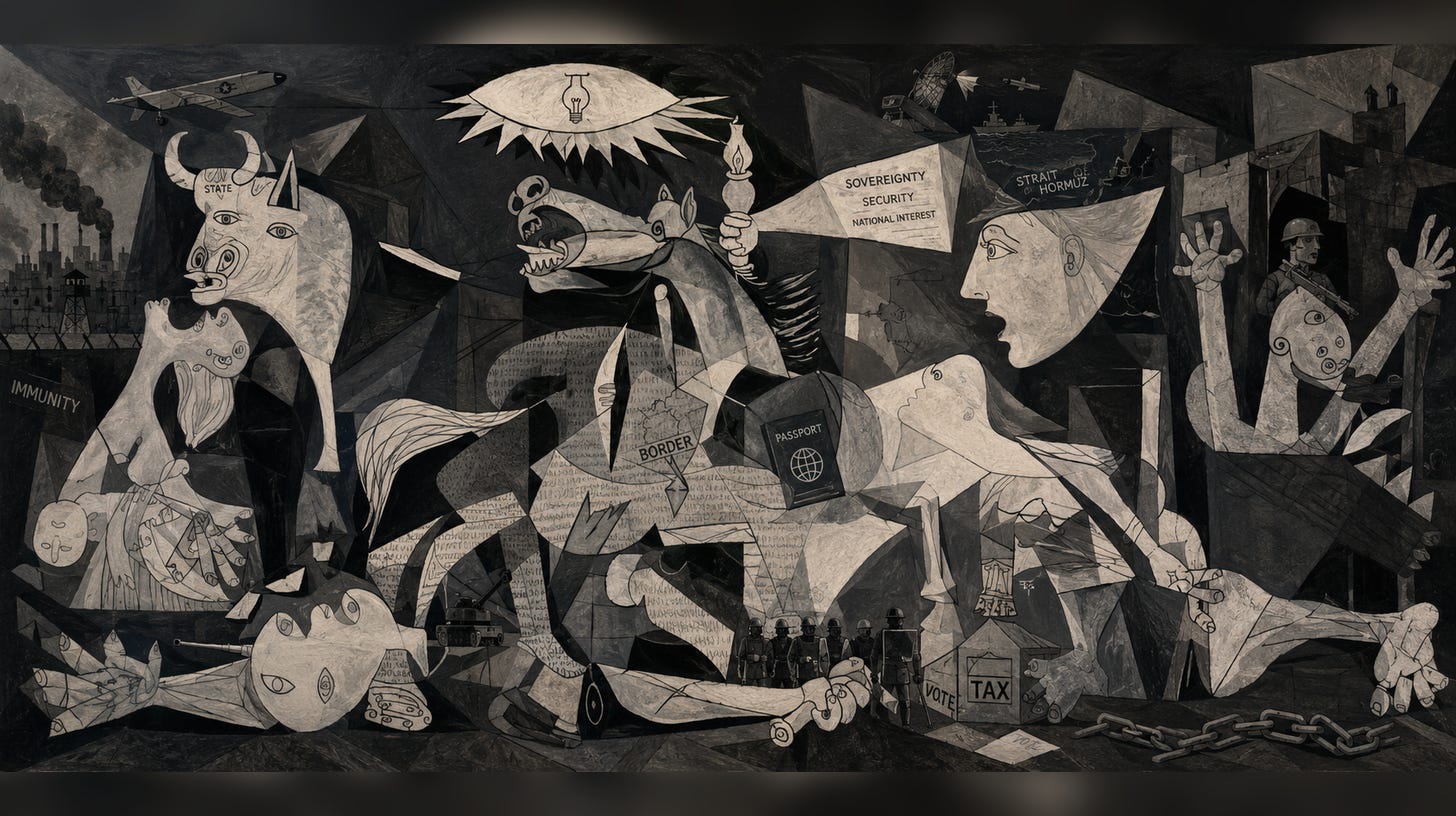
On June 17, the United States and Iran signed a memorandum of understanding that included a ceasefire and a framework for further negotiations. Ten days later, they were striking each other again. American warplanes hit Iranian drone storage facilities and coastal defense sites. Iran’s Revolutionary Guard fired back at U.S. military positions in Kuwait and Bahrain. Each side accused the other of violating the ceasefire. Each side described its own violence as a response, not an initiation. Each side was telling the truth — from the perspective of its own power structure.
This pattern — ceasefire signed, ceasefire fractured, mutual accusations, mutual escalation — is not a failure of diplomacy. It is what happens when two power organisms, each running the same survival logic, collide over the same strategic resource. The Strait of Hormuz is not merely a shipping lane. It is a boundary where two immune systems overlap, and neither can tolerate the other’s presence without triggering a defensive response.
This essay is not about Iran, America, or Israel. It is not an argument for moral equivalence. It is an attempt to look beneath the language of democracy, autocracy, sovereignty, and national security, and observe the shared architecture of state power itself. When states feel threatened, they do not behave like moral persons. They behave like organisms: identifying threats, mobilizing violence, protecting boundaries, consuming narratives, and restoring homeostasis.
That is why this moment feels so revealing. The crisis is not only about who violated the ceasefire. It is about the state as a species — and the survival logic that no ceasefire can override.
This is the first long essay in a series: Rethinking the State: An Evolutionary History of a Power Species.
It moves in seven steps: from the genealogy of power across three hundred thousand years, to the claim that all states are one species, to the state reimagined as a living organism, to ideology as food rather than identity, to homeostasis as the hidden logic of both democracy and autocracy, to power natural selection, and finally to the question that the framework forces us to ask: if the state cannot produce equality, where does equality come from?
To understand why this pattern keeps repeating, we need to step back from the latest crisis and ask a more basic question.
———
Series Foreword
February 13, 2017. Kuala Lumpur International Airport. A woman approached a man and pressed a cloth laced with VX nerve agent onto his face. Twenty minutes later, Kim Jong-nam was dead. The world classified this as state terrorism — a political assassination carried out by a rogue regime on foreign soil.
February 28, 2026. Tehran. Israeli warplanes, guided by months of intelligence tracking by the U.S. Central Intelligence Agency, struck Ayatollah Khamenei’s compound in a coordinated barrage. Iran’s Supreme Leader was killed. The world classified this as a joint military operation — a strategic strike by two democracies against an authoritarian regime.
The two events are structurally identical: a sovereign state determined that an external individual posed a threat to its power structure, then deployed lethal violence to eliminate that threat. The only differences are scale and narrative packaging. North Korea used a cloth and two hired women. The United States and Israel used precision-guided munitions and an entire intelligence apparatus. The former was called an assassination. The latter was called a targeted operation. Strip away the language, and the same skeleton is exposed.
This cognitive discomfort is where this series begins.
We are accustomed to classifying states along the axis of “democracy” versus “authoritarianism,” as though this were the most fundamental division in human political organization. This framework is so deeply embedded that it feels less like an analytical tool and more like an instinct — as natural as distinguishing day from night. But if two states at opposite ends of this spectrum exhibit the same structural logic when exercising power, what is this framework failing to capture?
What is a state, really?
The question sounds simple, yet it is almost never taken seriously. Political science discusses how states govern. Economics discusses how states tax and spend. International relations discusses how states compete. But rarely does anyone step back and treat the state itself as the object of inquiry, asking a more basic question: this thing — this thing we are born into, pay taxes to, are bound by the laws of, and defined by the borders of — what is it, actually? Why does it exist? What logic does it follow?
State power has two faces. One looks outward. The other looks inward. They appear to be entirely different, but they belong to the same body.
The outward face is how sovereign states behave in international space. The VX agent at Kuala Lumpur airport and the bombs over Tehran are both expressions of this face. When a state determines that an external threat exists, it can project violence across any border. North Korea can do this. The United States can do this. The scale differs. The logic is the same.
The inward face is often quieter, and more absolute. The power that a Cambodian border officer holds over the traveler standing before him is not structurally different from the power that a U.S. customs agent holds over the person seeking entry. You may appeal, you may file a complaint, you may hire a lawyer — but in that specific moment, you face an asymmetric power relationship whose source is not the uniformed individual but the entire state apparatus behind them. A state can be desperately weak on the international stage and yet wield near-absolute power over every individual within its borders. North Korea has almost no capacity for international power projection, but its control over its domestic population exceeds that of nearly every other state on earth.
These two faces are not two different kinds of power. They are the same power projected in different directions. Outward violence is how a state’s power structure behaves when it encounters another state’s power structure. Inward asymmetry is how it behaves when it encounters an individual. The structure is the same. Only the scale of the counterpart changes.
We are taught to focus on the differences between states — democratic or authoritarian, free or repressive, open or closed. These differences are real, but they describe variations in the interface through which state power operates, not in its underlying architecture. Two computers may run entirely different operating systems, yet their hardware — processor, memory, input/output — obeys the same physical principles. Democracy and authoritarianism are differences at the operating-system level. This series is concerned with the hardware.
A note on what this series is not. It is not an anti-statist manifesto. It is not an argument for anarchism. It is not an attack on any particular political system. It does not seek to prove that the state is “bad,” any more than biology seeks to prove that a virus is “bad.” It merely attempts to offer a different lens — one that can see through ideological packaging and observe the power structure itself.
If this lens makes you uncomfortable, that may be precisely the sign that it is working.
Rethinking the State
Chapter One: A Genealogy of Power
Every piece of land on earth today belongs to a sovereign state. This fact is so taken for granted that we rarely notice how strange it is. Humans have lived on this planet for roughly three hundred thousand years. The sovereign state as the standard form of political organization has existed for roughly three hundred. That means for 99.9 percent of human history, the sovereign state did not exist. It is not the default form of human political organization. It is an extremely recent variant.
But power itself is not recent. The state is new; power is old. To understand the state, you cannot start with the state. You have to start with power — and trace how the same logic of power has been transmitted and transformed under different technological conditions.
The Tribe: Power in Its Original Form
Before settlement, humans lived in small, mobile groups for hundreds of thousands of years. The tribe was not an embryonic state, but it contained the basic grammar of power. A chief gained followers through personal capability — fighting skill, judgment, the legitimacy to distribute food. The combination of violence and distribution rights is the oldest recipe for power.
But tribal power had a fundamental constraint: exit freedom. Members could leave. If you refused to obey the chief, you could take your family and join another group, or form a new one. Mobility was a natural check on power. When people can vote with their feet, the ceiling on power is the tolerance threshold of followers. The chief’s power was not constrained by institutions. It was constrained by the cost of exit.
The tribal era also established another basic feature of power: kinship as a trust network. Who can be trusted, who shares in resources, who stands with you in conflict — the first answer to these questions was always blood relation. This was not a choice but an optimal solution under constraint: in a world without writing, contracts, or third-party enforcement, genetic similarity was the only credible commitment.
The power prototype that the tribe bequeathed to posterity, then, was this: violence as the ultimate arbiter, distribution rights as the source of legitimacy, kinship as the trust network, and exit freedom as the ceiling on power. These four elements will run through the entire story. Three of them were inherited. One was eliminated.
The Agricultural State: The Disappearance of Exit
Roughly ten thousand years ago, humans began to settle. This is usually narrated as the dawn of civilization, but from the perspective of power structure, the meaning of settlement was entirely different: it eliminated exit freedom.
Nomads could walk away. Farmers could not. Your survival depended on your field, your field depended on seasonal cycles, your seasonal cycles depended on irrigation and water sources — and these were typically controlled by some more powerful entity. Settlement turned people into predictable, locatable, extractable objects. This was the most important turning point in the history of power: not the coronation of some great king, but the moment humans lost the ability to vote with their feet.
Once exit freedom disappeared, the ceiling on power was no longer determined by the tolerance of the governed but by the extraction capacity of the governor. Every core institution of the agricultural state can be derived from this shift. Taxation was periodic extraction from a fixed population. Corvée and conscription were labor extraction from a fixed population. Law was the proceduralization of extraction. Bureaucracy was the organizational scaling of extraction capacity. The prerequisite for all of these institutional innovations was that the objects of extraction could not leave.
Yet agricultural state power was still subject to a technical constraint: the cost of information transmission. A ruler sitting in Chang’an or Cairo could not know what happened in a frontier village on any given day. Information delay meant that power had to be outsourced in layers. The central ruler could not manage every person directly; he had to rely on intermediaries — nobles, landlords, tribal chiefs, local officials. Each layer of intermediaries retained a portion of power and resources. The power structure of the agricultural state was therefore pyramidal: the will of the apex decayed as it traveled downward, and information from the base distorted as it traveled upward.
This produced an important consequence: the power of the agricultural state was immense but crude. It could tax, conscript, and execute, but it could not precisely know who each person was, where they were, or what they were doing. The pharaoh could marshal a hundred thousand laborers to build a pyramid, but he could not know the name of every one of them. The Roman emperor could levy provincial taxes, but he relied on the intermediary extraction of tax farmers, and how much was lost in the process he could never exactly know. The ruler of the agricultural state possessed a kind of blurry absolute power — unlimited in principle, imprecise in operation.
From tribe to agricultural state, what was inherited? Violence as the ultimate arbiter — inherited. Distribution rights as the source of legitimacy — inherited, only transformed from a chief distributing game to a king distributing land and titles. Kinship as the trust network — inherited, and institutionalized as dynastic succession. What changed? Exit freedom disappeared. This single change redefined the operating logic of the other three elements: violence no longer needed to win followers, distribution no longer required consent, and kinship was no longer the natural basis of trust but an institutional tool for hereditary power.
The Industrial State: The Rise of Precision
Roughly two hundred years ago, another technological revolution reshaped the structure of power. The political significance of the Industrial Revolution is usually told as the rise of democracy — the bourgeoisie overthrew the feudal aristocracy, parliaments replaced courts. But from the perspective of power structure, the true significance of the Industrial Revolution was entirely different: it solved the core defect of the agricultural state — imprecision.
Industrial technology gave the state three unprecedented capabilities.
First, standardization. The industrial state could assign every person a name, a number, an address. Census-taking, birth registration, passport systems, land registries — these seemingly neutral administrative tools were, in essence, the precise capture of populations by power. The pharaoh did not know the name of every laborer; the industrial state’s tax authority knows every dollar you earned last year.
Second, total mobilization. Napoleon’s conscription system tells us more about the nature of the industrial state than the Declaration of the Rights of Man. Conscription’s prerequisite was standardized population registration — you had to know who was a male of eligible age, where they were, how to reach them. Agricultural empires also conscripted, but relied on the intermediary mobilization of local lords, limited in both scale and speed. The industrial state was the first to bypass all intermediate layers and reach every individual directly. This was not liberation. It was a leap in the resolution of power.
Third, ideological production. The legitimacy of the agricultural state rested on divine mandate, divine right, or the fact of conquest — narratives that did not require anyone to genuinely believe in them, only the absence of alternatives. The industrial state was the first to possess the capacity for the mass production of ideology: compulsory education. A mandatory, standardized, state-designed education system whose core function was not the transmission of knowledge but the production of standardized citizens — speaking the same language, identifying with the same nation, internalizing the same narrative. Before the French Revolution, only half of France’s population spoke French. Compulsory education raised this to nearly one hundred percent within two generations. This was not enlightenment. It was software installation.
Standardization, total mobilization, and ideological production — the combination of these three capabilities upgraded the blurry absolute power of the agricultural state into precise absolute power. The industrial state not only knew who you were, where you were, and what you were doing — it could also shape who you believed yourself to be. This was an entirely new form of power: extracting not only your resources and labor, but your identity.
From agricultural state to industrial state, what was inherited? The monopoly on violence — inherited. Territorial extraction — inherited. Population binding — inherited. What changed? Precision. The industrial state did exactly what the agricultural state had always done — extract resources, control populations, monopolize violence — but with infinite precision. And this very precision was precisely why it needed to be packaged as something else. When power becomes precise enough to touch every individual, it needs every individual to feel that this is legitimate. Democracy is not the opposite of power. It is the most efficient legitimacy interface for precise power.
The Global Operating System: The Forced Installation of Sovereignty
Once the industrial state proved its efficiency, the next question was: how did it go from being a regional European product to being the only legitimate political form on earth?
The answer is not imitation. It is forced installation. This process was completed in three steps.
The first step was the colonial system. As European industrial states expanded globally, they did not immediately export the sovereign state form to their colonies. On the contrary, the colonial system’s first move was to destroy existing political organizations — tribal alliances, kingdoms, trading networks, religious communities — and replace them with colonial administrative divisions. Africa’s national borders were drawn with rulers by European diplomats in a Berlin conference room. These lines cut through existing tribal, linguistic, and trade networks, but they were later inherited as the borders of sovereign states — not because they were meaningful, but because they already existed.
The second step was the principle of “national self-determination.” After World War I, Woodrow Wilson’s principle of national self-determination appeared to be a reaction against colonialism, but in reality it completed the global legitimation of the sovereign state form. Its subtext was: every nation has the right to its own state — and only a state. Not a commercial league, not a city network, not a tribal federation — only a sovereign state conforming to the Westphalian template. The content of self-determination was free, but its form was predetermined.
The third step was the United Nations system. The international order established after World War II hardened the sovereign state form as the only recognized political entity. United Nations membership is open only to sovereign states. International law recognizes only relations between sovereign states. Any political organization that did not adopt this form was regarded as “failed” or “incomplete” — as though the sovereign state were the mature form of political organization rather than one particular variant under particular historical conditions. By the end of the twentieth century, this process was essentially complete: no piece of land on earth did not belong to some sovereign state.
This was not natural diffusion. No African tribe, no Pacific island society, no Central Asian nomadic group “chose” the sovereign state form. They were absorbed into it, just as you are absorbed into a tax system that existed before you were born — without your consent, and even without your awareness. The sovereign state was an operating system that was forcibly installed, and it successfully deleted the visibility of all alternatives.
From tribe to agricultural state to industrial state, the basic grammar of power never changed: monopoly on violence, resource extraction, population control. What changed was precision and scale. Tribal power was crude and limited, constrained by exit freedom. The agricultural state’s power was absolute but blurry, constrained by information costs. The industrial state’s power is absolute and precise, and it has successfully disguised itself as the only possible form of human political organization.
Recognizing this is where rethinking the state begins. The question is not what the state should be like — but whether the state, as a form, is the only possibility.
This essay is part of Rethinking the State: An Evolutionary History of a Power Species.
Part I: The State Is Not a Moral Person ← You’re here
Part II: One Species, One Organism
Part III: Narrative, Homeostasis, and the State’s Survival Logic
Part IV: Power Natural Selection and the Question of Equality
About the Author
Deep Bitcheese Brew is not the name of a single author, but a collaborative thought-creation entity formed through ongoing dialogue between a human and AI. It represents a new mode of knowledge production: the human contributes experience, intuition, historical memory, and cultural judgment, while AI helps with association, structural reasoning, and iterative refinement.
Through this process, ideas are not simply written but brewed — tested, recombined, and clarified over time. The work of Deep Bitcheese Brew explores the evolution of technology, civilization, and social structures, with particular attention to how knowledge, institutions, and cultural narratives are reshaped in the age of digital networks and hybrid intelligence.
For a fuller statement of this project’s origins and method, see the Deep Bitcheese Brew manifesto: The Game Has Begun.
Really interesting history on how technology enabled different forms of power. I am curious - and only because it wasn't explicitly stated, perhaps due to the fact that it's likely obvious: why do we even need power structures to begin with?
As far as I can tell, we created positions of power to solve for decision making in a large group. Even the most basic tribal power structures relied on having some solution for group decision making and coordination. The forms of 'how decisions get made' changes as groups get larger and technology enables new possibilities, but we still seem to require some form of group decision process.
I'm assuming power structures exist in part because they also provide benefits from being part of the group - shared resources, protection from enemies or natural predators, delegation of complex projects everyone benefits from (e.g. roads). Perhaps that's simply a state narrative installed on its citizens so that they agree to continue to feed the state, but it's hard to imagine how else public infrastructure could created.
Of course AI poses a question mark over everything. Maybe coordination through elected powerful individuals evolves into AI systems that manage coordination - but it shifts greater power to whomever creates and tunes the models and how they're deployed. It still poses questions about what to do wrt group decision making.